
Before reading purchase conversion, check what counts as a purchase. Someone staying near checkout, a customer who pays and a POS transaction are different observations. Align their units and time windows before combining video and payment data.
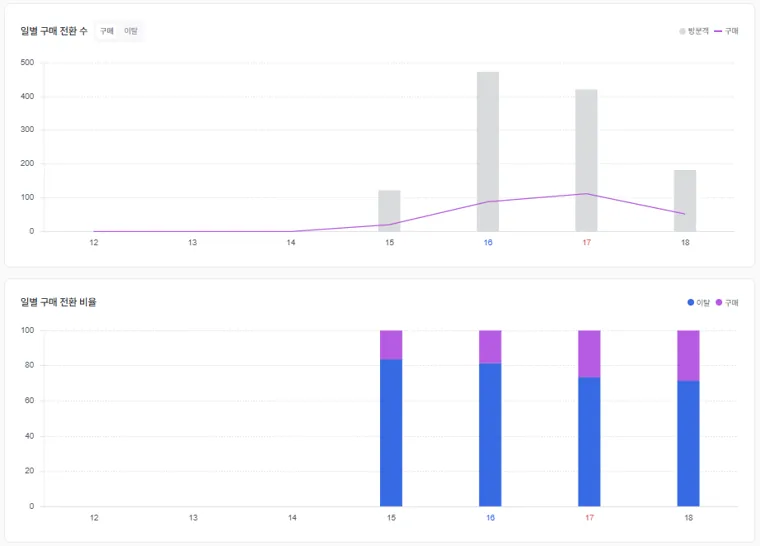
Whether an observed value represents completed payment depends on its source and configuration. Checkout presence alone cannot confirm payment. The product screen is in Korean.
Separate purchases from observed behavior
Customer purchase conversion is the number of purchasing customers divided by visiting customers in the same period. If your POS supplies transaction counts, do not assume they equal unique purchasing customers. One customer may split a payment, while several companions may share a transaction.
A ratio based on people who remain in a checkout zone for a specified duration is a separate, behavior-based indicator. Waiting, questions, companions and pass-through traffic can contribute. Display its counting rule alongside its name.
The difference is not a count of abandoned purchases
Consider a hypothetical example: 120 people observed near checkout and 100 POS transactions. Subtracting them does not establish that 20 people abandoned a purchase. People and transactions are different units, and repeated observations or companions may be included.
Align the time window and check zone boundaries, minimum dwell conditions, repeat-visit handling and cancelled transactions. A remaining difference is a signal to investigate. It does not establish a particular customer's non-purchase or its cause.
Look at stages outside the POS record
POS data describes paid transactions. Passing a shelf, inspecting a product, picking it up and putting it back, or leaving without buying are difficult to understand from transaction records alone.
Shelf analysis and funnel analysis can add observations about these stages. They do not reveal behavior outside the measurement scope. A pickup is not a purchase.
Ask the same question before and after a change
Match weekdays and hours, and record changes in prices, promotions, stock and staffing. After changing a price label, examine exploration and pickup separately from actual payment data. Even if both move together, review other operating conditions before attributing the change to your intervention.
Before adopting or sharing a report, record each metric's data source, unit, denominator and period. See the saai insight overview for the analysis scope, then confirm payment integration and counting definitions for the actual installation.
Sources · References
The numbers are hypothetical calculations explaining the counting units, not measured store results or customer outcomes. Keep the product screen’s observation rules separate from the definitions used for additional calculations.
